
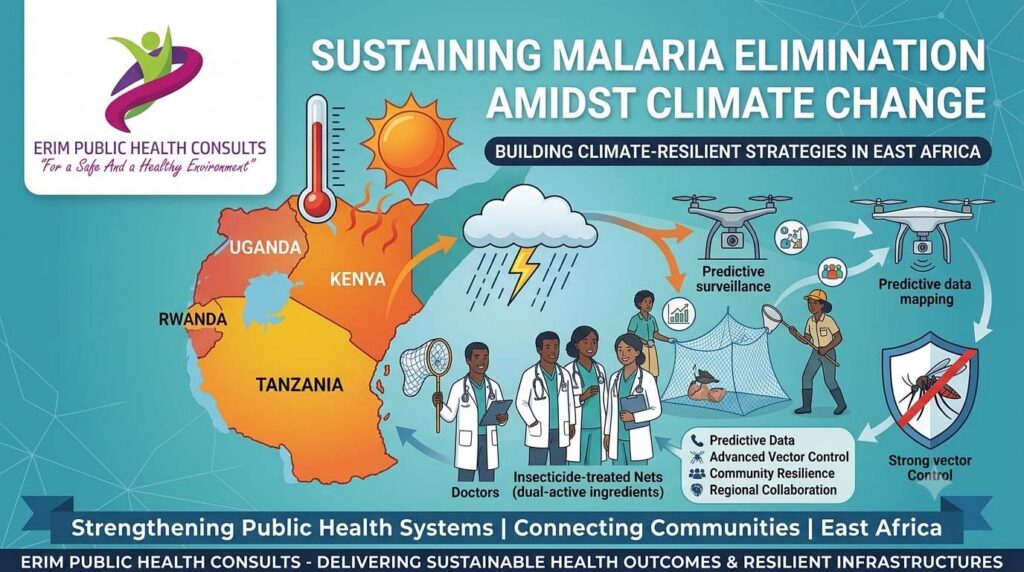
For decades, the fight against malaria across East Africa has been a cornerstone of regional public health strategies. Through coordinated vector control, widespread distribution of insecticide-treated nets (ITNs), and improved access to artemisinin-based combination therapies (ACTs), communities have made commendable strides toward suppression and elimination.
However, an shifting adversary threatens to undo these hard-won gains: climate change.
As global temperatures fluctuate and weather patterns become increasingly erratic, the landscape of malaria transmission is changing. To protect our communities and build resilient health infrastructures, public health frameworks must adapt to these environmental pressures.
The Climate-Malaria Nexus: Changing the Rules of Engagement
Climate change impacts malaria transmission primarily through three interrelated environmental levers: temperature, rainfall, and extreme weather events.
1. The Warming of Highland Zones
Historically, high-altitude regions in East Africa (such as parts of southwestern Uganda and the Kenyan highlands) were natural strongholds against malaria. The cool mountain air kept temperatures below the threshold required for the Anopheles mosquito to thrive and for the Plasmodium parasite to develop.
Today, rising baseline temperatures are transforming these highlands into viable transmission zones. Populations living in these areas historically possess low immunity to malaria, making the sudden introduction of the disease particularly dangerous and prone to triggering severe epidemics.
2. Erratic Rainfall and Vector Proliferation
While prolonged droughts present their own severe public health crises, unpredictable and intense rainfall cycles create a compounding problem. Heavy downpours leave behind stagnant pools of water—the perfect breeding grounds for mosquitoes. Conversely, subtle variations in seasonal rains can lengthen the high-transmission window, turning what used to be a predictable, manageable seasonal spike into a prolonged, year-round threat.
3. Disruption of Health Infrastructures
Extreme weather events, such as flash floods, do more than just breed vectors; they actively dismantle local health infrastructure. Floods displace vulnerable communities, cut off supply chains for essential anti-malarial drugs, and severely compromise sanitation systems. In these chaotic environments, community-level surveillance drops, creating blind spots where outbreaks can spread unchecked.
Sustaining Elimination: A Climate-Resilient Strategy
To prevent a resurgence of malaria, our public health systems must evolve from reactive treatment models into predictive, climate-resilient frameworks. Sustainable elimination amidst climate shifts requires action across four key pillars:
1. Integrated Climate-Health Surveillance
We can no longer operate health surveillance in a vacuum. Public health data must be systematically integrated with meteorological data. By tracking shifting rainfall patterns, humidity levels, and temperature anomalies, health departments can deploy early warning systems. If data indicates an upcoming climate anomaly favorable to vector breeding, resources—such as indoor residual spraying (IRS) campaigns and rapid diagnostic tests (RDTs)—can be positioned in high-risk zones before an outbreak begins.
2. Diversifying Vector Control Options
As mosquitoes adapt to shifting environments and show rising resistance to traditional pyrethroid-based insecticides, we must diversify our toolkit. This involves scaling up next-generation dual-active ingredient bed nets, expanding targeted larval source management (LSM) in predictable breeding sites, and investing in continuous entomological monitoring to track mosquito behavior changes driven by local microclimates.
3. Community-Centered Climate Adaptation
Sustainable outcomes rely on strong community roots. Public health training must equip community health workers with the knowledge to recognize how environmental changes affect disease risks. Empowering communities to manage local water drainage, maintain sanitation infrastructures, and recognize early symptoms in newly exposed regions is vital to reducing transmission.
4. Cross-Border Collaboration
Climate change respects no political borders. A weather system that triggers heavy flooding in one country will inevitably affect its neighbors. Sustaining elimination requires synchronized regional policies across East Africa, encompassing shared data registries, collaborative cross-border vector mapping, and unified response protocols during extreme weather emergencies.
Building the Future of Resilient Public Health
The challenge of climate change requires public health professionals, international development partners, and local governments to break down traditional silos. We cannot achieve sustainable health outcomes without directly addressing the environmental realities of our time.
By investing in predictive data systems, strengthening localized infrastructure, and fostering resilient, community-led interventions, we can protect our historical progress and advance confidently toward an ultimate goal: a malaria-free East Africa.
For decades, the fight against malaria across East Africa has been a cornerstone of regional public health strategies. Through coordinated vector control, widespread distribution of insecticide-treated nets (ITNs), and improved access to artemisinin-based combination therapies (ACTs), communities have made commendable strides toward suppression and elimination.
However, an shifting adversary threatens to undo these hard-won gains: climate change.
As global temperatures fluctuate and weather patterns become increasingly erratic, the landscape of malaria transmission is changing. To protect our communities and build resilient health infrastructures, public health frameworks must adapt to these environmental pressures.
The Climate-Malaria Nexus: Changing the Rules of Engagement
Climate change impacts malaria transmission primarily through three interrelated environmental levers: temperature, rainfall, and extreme weather events.
1. The Warming of Highland Zones
Historically, high-altitude regions in East Africa (such as parts of southwestern Uganda and the Kenyan highlands) were natural strongholds against malaria. The cool mountain air kept temperatures below the threshold required for the Anopheles mosquito to thrive and for the Plasmodium parasite to develop.
Today, rising baseline temperatures are transforming these highlands into viable transmission zones. Populations living in these areas historically possess low immunity to malaria, making the sudden introduction of the disease particularly dangerous and prone to triggering severe epidemics.
2. Erratic Rainfall and Vector Proliferation
While prolonged droughts present their own severe public health crises, unpredictable and intense rainfall cycles create a compounding problem. Heavy downpours leave behind stagnant pools of water—the perfect breeding grounds for mosquitoes. Conversely, subtle variations in seasonal rains can lengthen the high-transmission window, turning what used to be a predictable, manageable seasonal spike into a prolonged, year-round threat.
3. Disruption of Health Infrastructures
Extreme weather events, such as flash floods, do more than just breed vectors; they actively dismantle local health infrastructure. Floods displace vulnerable communities, cut off supply chains for essential anti-malarial drugs, and severely compromise sanitation systems. In these chaotic environments, community-level surveillance drops, creating blind spots where outbreaks can spread unchecked.
Sustaining Elimination: A Climate-Resilient Strategy
To prevent a resurgence of malaria, our public health systems must evolve from reactive treatment models into predictive, climate-resilient frameworks. Sustainable elimination amidst climate shifts requires action across four key pillars:
1. Integrated Climate-Health Surveillance
We can no longer operate health surveillance in a vacuum. Public health data must be systematically integrated with meteorological data. By tracking shifting rainfall patterns, humidity levels, and temperature anomalies, health departments can deploy early warning systems. If data indicates an upcoming climate anomaly favorable to vector breeding, resources—such as indoor residual spraying (IRS) campaigns and rapid diagnostic tests (RDTs)—can be positioned in high-risk zones before an outbreak begins.
2. Diversifying Vector Control Options
As mosquitoes adapt to shifting environments and show rising resistance to traditional pyrethroid-based insecticides, we must diversify our toolkit. This involves scaling up next-generation dual-active ingredient bed nets, expanding targeted larval source management (LSM) in predictable breeding sites, and investing in continuous entomological monitoring to track mosquito behavior changes driven by local microclimates.
3. Community-Centered Climate Adaptation
Sustainable outcomes rely on strong community roots. Public health training must equip community health workers with the knowledge to recognize how environmental changes affect disease risks. Empowering communities to manage local water drainage, maintain sanitation infrastructures, and recognize early symptoms in newly exposed regions is vital to reducing transmission.
4. Cross-Border Collaboration
Climate change respects no political borders. A weather system that triggers heavy flooding in one country will inevitably affect its neighbors. Sustaining elimination requires synchronized regional policies across East Africa, encompassing shared data registries, collaborative cross-border vector mapping, and unified response protocols during extreme weather emergencies.
Building the Future of Resilient Public Health
The challenge of climate change requires public health professionals, international development partners, and local governments to break down traditional silos. We cannot achieve sustainable health outcomes without directly addressing the environmental realities of our time.
By investing in predictive data systems, strengthening localized infrastructure, and fostering resilient, community-led interventions, we can protect our historical progress and advance confidently toward an ultimate goal: a malaria-free East Africa.
More Blogs
How Can We Sustain Malaria Elimination Efforts Amidst Climate Change?
For decades, the fight against malaria across East Africa has been a cornerstone of regional public health strategies. Through coordinated vector control, widespread distribution of